Thursday, April 19, 2018

Grafting to Wild Apple Trees

Yesterday I "top worked" some wild apple trees that had not produced any fruit. I cut the trees back rather severely last spring to promote sucker growth and used the cleft grafting technique to graft to the new growth. I waited until the leaves had begun to open to improve my chances for success.


After wrapping with parafilm I added a couple of wraps of masking tape just to made the graft more secure and put a covering of toilet bowl wax on the tip of the scion to keep it from drying out.


 With the large established root system of the older apple trees and if my grafting is successful the scion should be producing apples in a few years, much faster than grafting to rootstock and waiting for the tree to develop.

Friday, April 6, 2018

The Grafting Season

Here on the homestead I'm well into my grafting season. The Tina left-handed grafting knife that I bought last year has been one of my best investments. I've now conquered the difficult (to me) whip and tongue graft and am using it on the appropriately sized scion and rootstock. I still use the cleft graft when the scion is smaller than the rootstock.
 
The Tina
 
The whip and tongue graft while not necessarily a better graft than a cleft graft is a "cleaner looking" graft, but is best used when the scion and rootstock are nearly the same diameter size. Here I am cutting the "tongue" on a whip and tongue graft.
 And the finished graft.
 
I'm excited about the rare Limbertwig scions I was able to obtain this spring. The Limbertwig family of apple trees originated in the southern Appalachian mountains. Grown from seeds on isolated homesteads in the 1800's they are noted for their unique taste and versatility as a fresh eating apple,  a fine cider apple and also good for making apple butter and drying. Many although not all of the varieties have a weeping growth habit from their slender limbs that bend down under the weight of their apple crop. At one time over 50 varieties of Limbertwigs were known but many have become extinct. I currently have 8 varieties growing in my orchards and was able to get scion of 10 more varieties this spring.
There must have been an interesting story behind the naming of this variety of Limbertwig.

 A bucket full of just grafted Limbertwigs
Anyone interested in learning more about the Limbertwig family of apples can read an interesting article on Ron Joyner's blog at www.bighorsecreekfarm.com


Tuesday, March 20, 2018

2018 Spring Woodcock Adventures

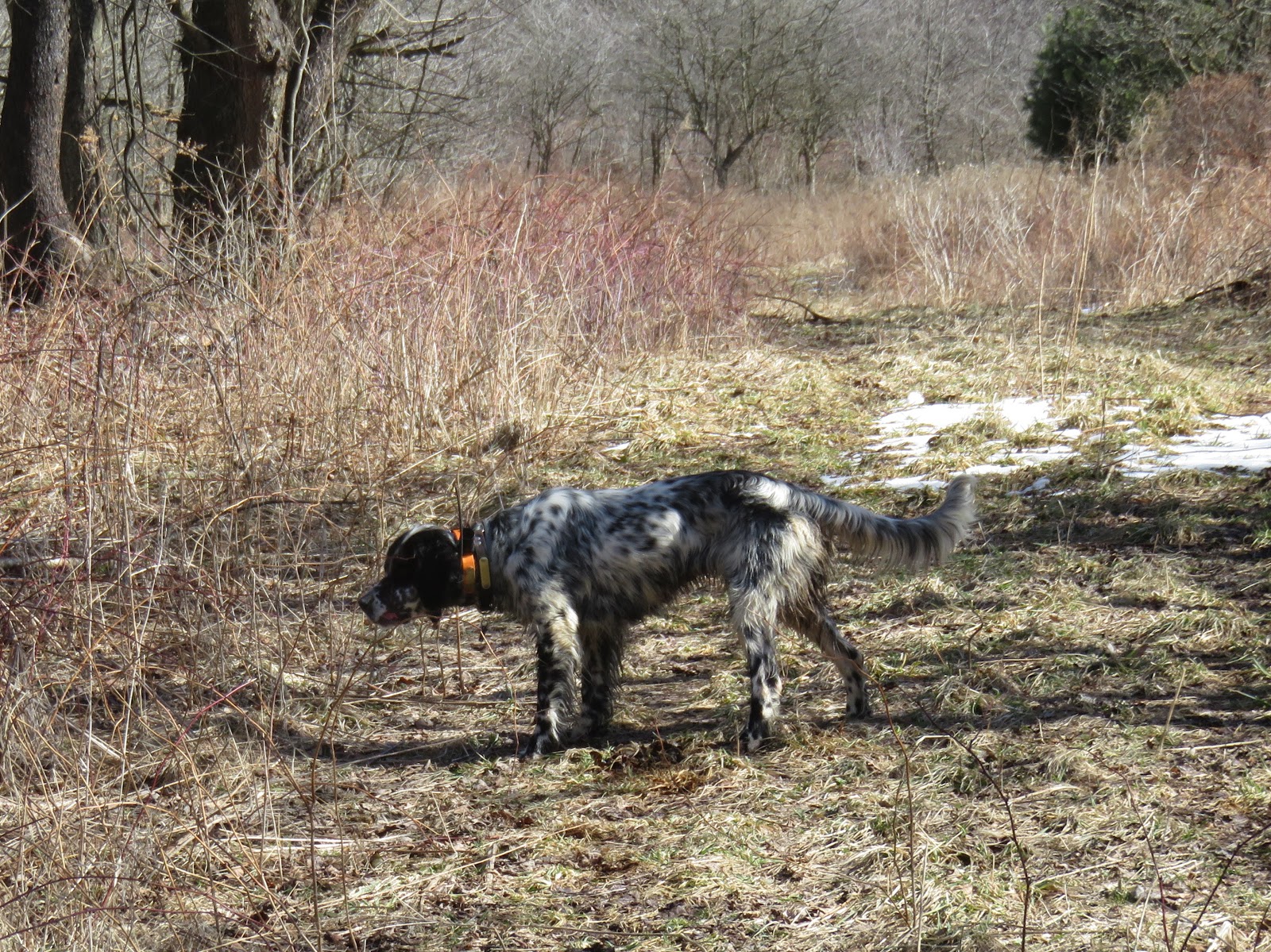
It's been an odd spring this year, or at least it seems like it to me. Warm weather in February with plenty of rain and no snow, then March comes in like a lion with cold temperatures and winds but still not much snow.  The dogs and I have only been out a few a times, maybe I'm getting soft in my old age but I didn't feel like I should be "harassing" the woodcock with the cold nightly temperatures we have been having. Here are some pics of the few times we've been out.

 
Thicket and I hunted the Buffalo Covert one day. She moved two woodcock but didn't have any solid points.


We found a dead Pheasant which was strange because I've never seen a Pheasant in this cover in close to 20 years of hunting it.
 
I also found a dead Great Horned Owl which was even stranger. No obvious wounds on it.

 
As always Thicket had a great time.
 
 
I took Emma on my next woodcock walk. She's approaching 11 years old and time is robbing her of her stamina, but not her nose. She found 2 woodcock along Piney Creek.


Thicket and I tried the Miller's Corner covert on our next walk. Some nice looking cover, but no woodcock where there that day.


Emma got the call next to run in the big Shawnee Creek covert. She had one productive point and a couple of empty points.


Yesterday Thicket and I traveled north to look at a hawthorn regeneration project. The Pa Game Commission had cut this area 5 years ago in hopes of stimulating hawthorn growth. Sadly I didn't find any new hawthorn saplings growing there, just some locust and birch saplings and plenty of blackberry briers and multiflora rose.


Thicket did find one woodcock and gave me a nice point.
 
That could have been the end of my spring woodcock walks. As I type this we're getting hit by a pretty good snowstorm with 6 to 10 inches of snow predicted.  The woodcock are hopefully hunkered down beneath a blowdown or multiflora rose bush close to a spring seep to wait out the storm. I've found nests by now other years. Brutal but that's just the way Mother Nature works.


Monday, February 26, 2018

First Woodcock

Thicket found one woodcock on our run yesterday at the Old Biddle Place.


Saturday, February 24, 2018

February Pictures

A rainy Saturday gave me an chance to catch up on my blog.

A Golden Russet before pruning.
And after pruning. Although it looks quite sever the tree will put out plenty of new growth this summer.
 
 The Bluebirds are back and claiming their boxes.


A Mockingbird posing for me.
 
I spent several winter days building birdboxes. I built about a dozen to be scattered about the Homestead for Bluebirds, Tree Swallows, and Chickadees. Although Titmice and Nuthatches will also use a  birdbox I haven't been able to lure any to my boxes yet.
 
 
I had to evict some mice who spent the winter in some of the boxes.


I cut scion wood from my apple trees in February. Scion wood is the one year old wood that grew on the tips of the branches last summer. This is the wood that I graft with. After being cut into lengths that fit in a gallon freezer bag I dip the ends in wax to keep the wood from drying out until I use it. Then it is stored in the refrigerator. Some of this scion will be shipped to grafters across the country that I have met through internet boards and I will in turn receive scions from them of trees I'm not growing yet


 The ice melted off the vernal pond a couple of days ago and the wood frogs have come looking for mates.


Our Black Pussy Willow bush says it's spring.


Several sunny days have the bees out and about.
 
Hopefully next week Thicket and I will be in the woodcock coverts looking for returning birds.